Flat Tappet Conversion: The Best Upgrade to Bulletproof Your 5th Gen Cummins
Since 1989, Cummins has manufactured inline-6 engines specifically for Dodge (now Ram Trucks), part of an engine family known as the B-Series. After five generations, the partnership between Ram Trucks and Cummins has produced one of the most well known and popular diesel pickup trucks in the United States. While Chevy’s Duramax and Ford’s Powerstroke are produced in house (although, the Duramax was developed by both GM and Isuzu), heavy duty Ram Pickup trucks proudly wear the Cummins badge on their fenders.
The Problem
While Cummins engines are known for their reliability, longevity, power, and fuel economy, the 6.7 liter engine found in the 5th generation Ram ( 2019 +) switched from flat tappets to hydraulic, roller style ones. While this change was made to improve driver comfort by quieting the engine, improving efficiency and reducing maintenance, the change led to an increase in premature engine failures. Continue reading to learn the difference between hydraulic lifters and flat tappets, how the lifters in the 5th Gen Cummins fail, and the fix that can bulletproof your engine!
What are Valve Lifters?
Valve lifters (also called tappets) convert the rotational movement of the camshaft into an up and down motion, opening and closing intake/exhaust valves. Internal combustion engines are essentially giant air pumps. In order to create power, oxygen needs to enter the combustion chamber and exhaust needs to be expelled. The cylinder head, which sits above the engine block, contains the valves controlling intake and exhaust.
There are a few different configurations for valvetrain setups, including:
- Overhead Cam (single, dual)
- Overhead Valve (pushrod)
- Flat Head (also called side valve)
Lifters come in a few different styles. Some have a roller that runs on the cam lobe, others have a flat face.
Cummins engines are an overhead valve engine, meaning the camshaft transfers energy to the valves through long pushrods that run through the engine block. The contact point between the pushrod and the cam is where the valve lifter sits.
Hydraulic vs Solid Lifters
Hydraulic lifters rely on oil pressure to keep in contact with the cam lobe. They maintain zero clearance between the contacting surfaces, leading to quieter and more efficient operation. As a result, hydraulic lifters do not require adjustment throughout the life of the engine.
Solid lifters are just that; solid. They are not controlled by oil pressure, and require manual adjustment to set lash, which is the gap between the tappet/lifter head and the lobe of the cam.
Lash is set to account for the expansion of the metal with heat, and periodically needs to be adjusted in order to maintain optimal valve function. Solid lifters are typically more reliable, since they are not dependent on oil pressure to function. The tradeoff is more noise, and the need for periodic adjustments.
Why Do Cummins Hydraulic Lifters Fail?
Hydraulic lifters are dependent on specific oil weights, as well as frequent oil changes in order to keep the small passages within the lifter clear. With inadequate oil pressure, the lifter can seize in its bore, the rollers can fail, and the lifter can even rotate in its bore.
Roller Failure
A stuck roller will drag along the lobe of the camshaft, causing increased heat and wear and potentially destroying the cam.
Seized Lifter
The tolerances of the lifter bore (the hole it sits in) are very tight, which can cause inadequate oiling and cooling. As a result, the lifter can seize in the bore, causing it to stop working.
Lifter Rotation
The hydraulic lifters have a dowel pin just below the roller. This can back out, causing the lifter to rotate. This condition can quickly destroy your engine.
What are the signs of a failing hydraulic lifter on a 5th Gen Cummins?
Issues from a failing lifter can range from annoying to catastrophic. Here are some signs to look out for:
- Audible ticking from the engine
- Power Loss
- Rough Running
- Check Engine Lights
- Metal shavings in the oil pan/during oil changes
- Turbo failure
- Camshaft/Engine failure
The Fix: Flat Tappet Conversion
To prevent expensive repairs, a flat tappet conversion is a popular upgrade for the 5th gen Cummins. Switching to components from a company like Hamilton Cams simplifies and futureproofs your valvetrain by converting the system back to the solid lifter style used in Cummins engines until 2018. Eliminating the failure points in the valve train gives you peace of mind every time you get your truck, whether you’re hauling supplies to a job site or towing your camper on a road trip.
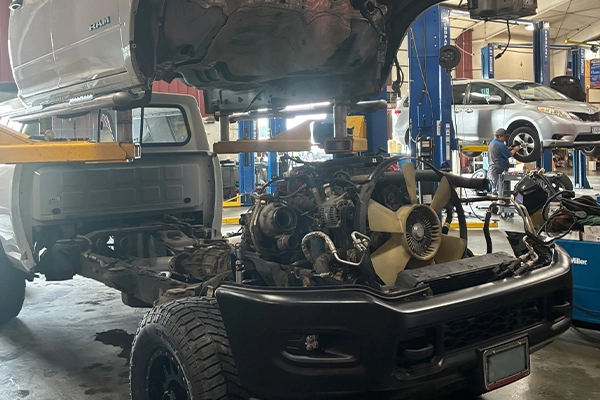
Dodge Cummins Flat Tappet Conversion in CDA, Rathdrum, and Spokane
If you drive a 5th Gen Cummins and live near Coeur d’Alene, Rathdrum, Hayden, or Spokane, Lake City Auto Care is your go to shop for diesel services. Our expert team will help you spec out the perfect flat tappet kit for your 6.7 Cummins, whether you are looking to do the conversion preemptively or you already are showing symptoms of hydraulic lifter failure. With locations in Hayden, CDA, and Rathdrum, Lake City Auto Care is a short drive away. Call or schedule an appointment online now!
North Idaho's Best Warranty
We stand behind our work 100%. That's why we offer a five-year, 50,000-mile warranty on all services and repairs. You can rest assured that when you bring your vehicle to us, we've got you covered no matter what happens down the road.
Appointments (208)-856-8336